Car seats are one thing that everyone must have in order
to leave the hospital and then for many years to come.
As with all the At Home Care pages, we start out with
infants and work our way up to bigger kids.
Car Beds
Most children born with hydrocephalus fall into the category of
preemie and/or big-headed. If this is the case your child will have to
pass a car seat test before they can be taken home. Preemies or
kids with big heads may not have the head control to keep
from slumping down in a car seat and cutting off their own airway.
The test typically requires you to bring in the child's actual
car seat. The child is then hooked up to a pulse-ox
- a device that measures pulse rate and oxygen level. They then leave the child in the
car seat for the same amount of time that your drive home is expected
to take. If you have a particularly long drive then they may allow
a few breaks to simulate stopping the car and getting out to stretch
your legs. If the child can keep their oxygen level in the normal
range then they can go home in their own car seat. If they cannot
then you will need to invest in a car bed which will allow them
to lie down for the ride home.
There are three different models of car beds, based on the child's
weight and how long you think you will need it.
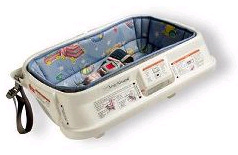
The Angel Ride Car bed is used for the smallest infants. The child
must weight less than 9 pounds and be less than 20 inches long. It
won't last long, but being a small bed it might be the most comfortable
for a really small baby, even though the other beds are also rated
for tiny ones.
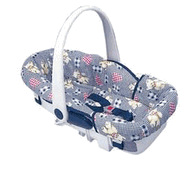
The Cosco Dream Ride Car Bed is a medium range bed. This is
actually the one that we used since Owen was over 9 pounds when he
was born. This bed is rated for babies 5-20 pounds and 19-26 inches long.
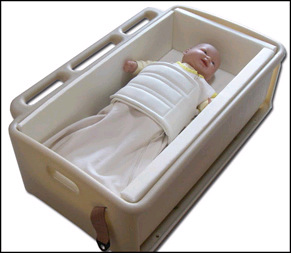
The Hope Car Bed is the largest of the three models and can accomodate
a child from 4.5 to 35 pounds and up to 29 inches (longer if you
don't mind their legs bending a bit). If you anticipate needing the
bed for a long time this might be a good choice.
Most hospitals either have car beds that they can loan you, or
they can help you get one so ask around first before you go and buy
one.
Some other thoughts to consider with the car beds are that they take
up considerably more room in the back seat than a normal car seat does.
I could just fit the Dream Ride in the back seat of my Honda Civic
with his sister's car seat next to it. I imagine that the
Hope Car Bed is somewhat larger and if you have a compact car
you are probably limiting yourself to just one car seat in the back.
This is also another place where the receiving blankets
that I rave about on my Positioning
page are useful. Rolling one up and putting it under the child's neck
can help to keep their airway positioned correctly. We also put
one rolled up on either side of Owen to keep his small body in the
center of the bed.
Infant Car Seats
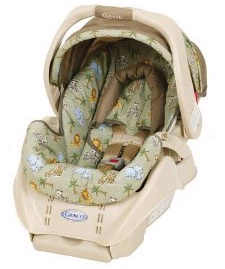
Before Owen was born we had purchased a standard Graco SnugRide
infant carseat. Infant car seats have a base that stays
in the car and you can just detach the carseat to bring inside.
These are
very convenient for little ones since you can keep them in the
seat if they are sleeping when you get home. You can also just
bring the seat into a restaurant and let the kiddo sleep away while
you eat (if you are that kind of lucky). The downside to these
is that they are only good for about the first year as they are
typically only rated to 20 pounds and they cannot be turned around to a
forward facing position. We used this when Owen outgrew the
need for his car bed, but with his big head he quickly outgrew
the infant seat.
Rear Facing Carseats
In every state that I know of, infants are required to be in rear
facing car seats until they are at least one year old. If you have
a child with a larger than normal head or who who has low muscle
tone you may wish to consider the idea of keeping them rear facing
for longer than the one year to give them extra time to develop
full head control.
We tried a number of convertible car seats (can be
either forward or rear facing) before we found one that
actually worked. We had a basic infant Graco rear facing
which worked allright for a few months, but his head
was so big that he outgrew it quickly. We tried a
Safety First All-in-One which was terrible because the back plate
pushed his body so far forward. We finally settled on one that
worked perfectly because it cradled his body so well.
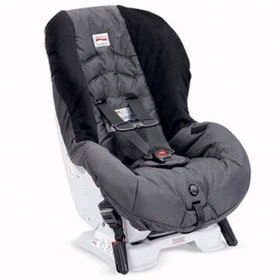
The Britax Roundabout is rated for rear facing to 35 pounds, and
is also snug enough to handle a 5 pound baby. It can be front
facing up to 50 pounds. Owen is four as of this writing and
we are still using it.
Car Seats for Older Children
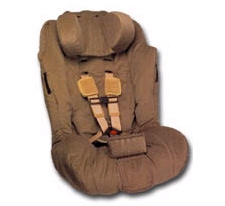
Britax and Snugseat have teamed up to create the Traveller Plus EL
which is rated for 22 - 105 pounds. It is a forward facing only
seat, but it has some nice special needs features including
extra lateral head support, easy reclining for
those with limited head support or low muscle tone,
a five point harness that fits much larger children than your
average car seat,
and an abductor to keep them from
sliding down. This is a fairly new product so we haven't tried it,
but it looks much more comfortable than many of the other special
needs car seats out there.
Legal Disclaimer: While every effort has been made to make certain that the information contained in this website is accurate, it must be remembered that the content is managed by a parent, not by a doctor. Information contained here is for general support purposes only and is no substitute for the care of a physician.