Now I have to put a disclaimer in here. I know that pediatricians almost universally hate walkers
because of the number of kids that fall down stairs in them. One parent that I told about
this invention told me that I was endangering my child's life. So I will just say the following:
1) This little contraption is meant to help provide independent movement to a child that
has no other alternative and it is not a babysitter. Owen was never left in it unsupervised, just
as no child of this age should be left unsupervised at any time unless they are in their crib.
2) Baby gates are cheap. Use them liberally about your house to prevent your child from
falling down the stairs, cruising out of your view while you are cooking,
or crashing into your fine china cabinet (or be like me and just
don't have any fine china!). 3) As I'm sure each of you has
the common sense to already know 1 and 2, I'll move on now.
I started out by buying a cheap walker. I knew I'd be drilling holes into it and I wasn't
sure that I had a design that would work, so I didn't want to start with a $50 deluxe model.
So instead I started with a $14.99 model that I bought on eBay.
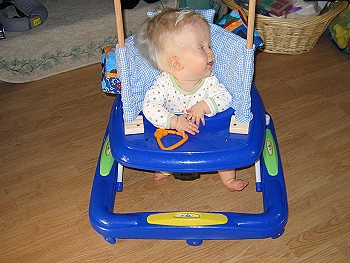
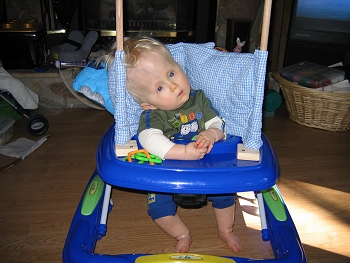
I used the same general idea as I did with the bouncer - to turn it into a corner seat.
I needed to have two poles in the front to attach the fabric panel
to. So I started by getting some 5/8 inch oak dowels. You need something strong enough
to handle some stress and oak is about the best you can get at Lowe's. I drilled a
5/8 inch hole in the corner of the tray area. I wanted to use two small blocks of wood
to stabilize the poles, so I drilled a 5/8 inch hole all the way through one and 3/4 of the
way through the other (despite the fact that it looks like I go all the way through in the
picture on the right. That was a mistake and I just put the 3/4 of the way through hole at the
other end of the block). I put the one with the hole all the way through on the top of the tray
and put the dowel down through it and the hole in the tray. Then I lined up the one with
the partial hole and put it over the end of the dowel. Finally I put a screw down through the
top block, through the tray and also most of the way through the bottom block. This pulled the
two blocks together and made the pole stable. I then repeated the procedure for the other
side:
I put some velcro on the back of the seat to attach the panel to. You need to pick a walker
with as high a back as possible. As you can see in the second picture below, the back wasn't
quite high enough and I had to add a small pillow at the top for additional support.
To help Owen support the weight of his head, I put in a strap that would go across his
torso. It was just two long strips of quilting material with one side of the velcro sewed
to one strip and the other side of the velcro on the other side of the strip.
The last thing to make was the fabric panel. I used quilting material that I stuffed a bit
to give it some support. It's just a big long rectangle with a piece of velcro sewed down the
middle to mate up with the velcro on the seat. I didn't try to velcro the panel to the poles,
I just wrapped the ends around the poles and sewed them in place.
All that was left was to put Owen in it.
Legal Disclaimer: While every effort has been made to make certain that the information contained in this website is accurate, it must be remembered that the content is managed by a parent, not by a doctor. Information contained here is for general support purposes only and is no substitute for the care of a physician.